

Electroacoustic and Acousmatic Music: A History
Electroacoustic music is the broad term for music made using electronic technology — whether that means recording and manipulating real-world sounds on tape or disc, generating sounds electronically from scratch with oscillators and synthesizers, or, later, processing and generating sound with computers. It emerged as a serious compositional practice in the years immediately after the Second World War, when composers in several countries, working almost simultaneously but with different aesthetic philosophies, gained access to recording studios built originally for radio broadcasting.
Acousmatic music is a specific and important strand within this broader field. The word comes from the Greek akousma, "a thing heard," and was revived by the French composer and theorist Pierre Schaeffer to describe a listening situation in which the sound source is invisible or unidentifiable — the listener hears the sound without seeing its cause, as when Pythagoras is said to have taught from behind a curtain. In musical terms, acousmatic music is composed and fixed on a recorded medium (originally tape, later digital audio) and is intended for loudspeaker performance rather than live instrumental performance; there is no score in the traditional sense, and no performer stands on stage manipulating an instrument in view of the audience. The composer works directly with recorded or synthesized sound as their raw material, shaping it in the studio the way a sculptor shapes clay, and the finished piece is "performed" by playing the fixed recording through an array of loudspeakers, often with a live diffusion artist adjusting the balance and spatial movement of the sound in the hall.
This essay traces how that practice arose and developed internationally from the late 1940s onward: the two rival studios that founded the field in Paris and Cologne, the very different aesthetic and technical premises behind musique concrète and elektronische Musik, the spread of studios to Italy, the United States, Britain, Scandinavia, the Netherlands, Poland, Japan, and Canada, the crucial shift from purpose-built studio hardware to commercially available voltage-controlled synthesizers in the 1960s, and the eventual convergence of all these strands into the computer-based practice of the later twentieth century. Along the way it explains the core technical distinction between subtractive synthesis (starting from a complex, harmonically rich sound source and removing unwanted frequencies with filters) and additive synthesis (building a sound up from scratch by combining simple sine tones), a distinction that maps closely onto the historical rivalry between the Paris and Cologne studios and that remains fundamental to synthesizer design today.
Precursors, to 1948
The idea of composing directly with sound rather than writing notes for performers to realise was in the air well before any studio existed to make it practical. The Italian Futurists were the first to argue for it in explicit terms: Luigi Russolo's 1913 manifesto The Art of Noises called for music built from the sounds of the modern industrial world — roars, whistles, hisses, screeches — and he built a family of mechanical noise-generating instruments called intonarumori to perform it. Russolo's instruments and scores are almost entirely lost, but the manifesto's central claim, that noise itself is legitimate musical material, became a founding premise for everything that followed.
In the following decades, composers experimented with the new electrical and electromechanical instruments becoming available: the Theremin (Russia, 1920), the Ondes Martenot (France, 1928), and the Trautonium (Germany, 1930), all of which generated continuously variable electronic pitches and were used by composers including Edgard Varèse, Olivier Messiaen, and Paul Hindemith. Varèse is a particularly important transitional figure. Long before he had electronic means available to him, he spoke of wanting to compose with "organized sound" rather than conventional melody and harmony, and he pursued electronic composition whenever he could get access to a studio, eventually producing Déserts (1954, alternating orchestral and tape sections) and the landmark Poème électronique (1958), composed for Philips at the Brussels World's Fair and played through hundreds of loudspeakers inside Le Corbusier's Philips Pavilion.
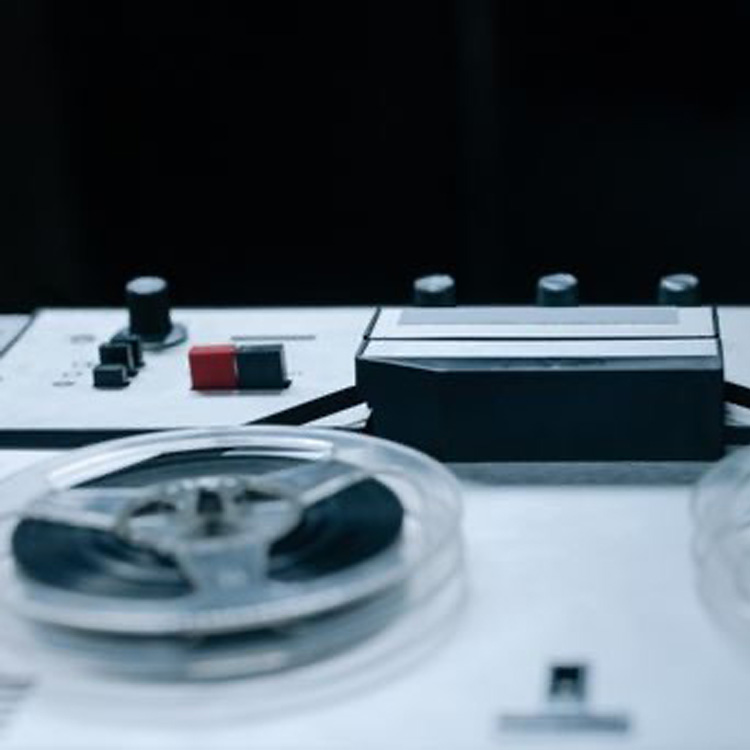
The technical breakthrough that made a real studio practice possible was magnetic tape recording. German engineers at AEG and BASF developed practical magnetic tape recorders (the Magnetophon) through the 1930s, using tape coated with iron oxide and, crucially, AC bias to reduce distortion — a technology that reached genuinely high fidelity by the early 1940s and remained secret to the wider world until Allied forces encountered German tape recorders at the end of the Second World War. American and British engineers reverse-engineered and improved the technology immediately afterward, and by the late 1940s good quality tape recorders were reaching radio stations across Europe and North America. Tape was transformative because, unlike a disc, it could be cut with scissors, spliced back together in a different order, reversed, played at different speeds (changing both pitch and duration together, since there was as yet no way to separate the two), and layered by copying from one machine to another. It gave composers, for the first time, a physical medium they could cut up and rearrange the way a writer edits a manuscript — and it is no accident that the two studios that founded electroacoustic music both grew directly out of radio engineering departments that already had this equipment to hand.
Paris: musique concrète and the birth of the studio (1948– )
The first electroacoustic studio in the world to produce finished, publicly performed compositions was founded not by a composer but by an engineer. Pierre Schaeffer (1910–1995) worked as a sound engineer for French radio, Radiodiffusion Française (RDF), and in 1948, using disc-cutting equipment in a small studio, he began experimenting with recorded sounds — a train, a spinning top, prepared piano, saucepans — treating them as raw musical objects rather than as recordings of real events. His Cinq études de bruits (Five Studies of Noises, 1948), broadcast on French radio in a programme he called a "concert of noises," is generally taken as the founding work of the whole field, and he coined the term musique concrète for it: "concrete" because the composer works directly and immediately with actual recorded sound, rather than working abstractly with notation that is only later "realised" by performers.
Schaeffer was quickly joined by Pierre Henry (1927–2017), a classically trained composer and percussionist, and the two collaborated on the Symphonie pour un homme seul (Symphony for a Man Alone, 1950), built from vocal sounds, breathing, footsteps, and knocking, which became one of the most influential works of the new medium and was later used for dance by Maurice Béjart. The studio was formally established as the Groupe de Recherche de Musique Concrète (GRMC) in 1951, moved into new premises within French radio (by then the ORTF), and was reorganised in 1958 as the Groupe de Recherches Musicales (GRM), which survives to this day as part of the Institut National de l'Audiovisuel (INA-GRM) and remains one of the most important acousmatic studios in the world.
Schaeffer's practice was empirical and philosophical as much as technical. He and his colleagues (notably the engineer Jacques Poullin, who built much of the studio's specialised equipment) developed a set of techniques for manipulating recorded sound that became standard vocabulary across the field: coupure (cutting a sound off abruptly instead of letting it decay naturally, which strips away the attack transient that normally helps a listener identify a sound's source); playing sounds backward; changing playback speed on variable-speed turntables and later on the Phonogène, a purpose-built keyboard-controlled tape machine Poullin devised that let a performer trigger tape loops at different transposed speeds; and layering multiple recordings by mixing between several disc players or tape machines simultaneously (the Pupitre d'espace, an early device for controlling the spatial position of sound across several loudspeakers). Schaeffer's central theoretical concept was the objet sonore (sound object): the idea that a listener can, through repeated and "reduced" listening (écoute réduite), attend to a sound purely as a sound — its shape, grain, mass, and behaviour in time — independent of what physically produced it or what it might be taken to mean. This is the direct root of the acousmatic idea: by removing the visual and contextual cues that normally tell a listener what caused a sound, the composer frees the sound to be heard, and composed with, as pure sonic material. Schaeffer worked out this theory in enormous detail in his Traité des objets musicaux (1966), still a foundational text for acousmatic composition and for the discipline that grew from it, electroacoustic music analysis.
Crucially, the Paris approach began from real, recorded sound and worked by selecting, transforming, and montaging it — an essentially empirical, ear-led, trial-and-error method, deliberately opposed to the more theoretical, pre-planned approach that would shortly emerge in Germany. This distinction between working "from the recorded object outward" (Paris) and working "from abstract calculation upward" (Cologne) is one of the two founding aesthetic poles of the entire field, and both approaches persist, in updated technical guises, in electroacoustic composition today.
Cologne: elektronische Musik and the triumph of the sine tone (1951– )
Within three years of Schaeffer's first broadcasts, a rival and philosophically opposed studio was founded in West Germany. The Nordwestdeutscher Rundfunk (soon reorganised as Westdeutscher Rundfunk, WDR) in Cologne established an electronic music studio in 1951 under the direction of Werner Meyer-Eppler, a physicist and phonetician at Bonn University who had been researching the analysis and synthesis of speech sounds, together with the composer and critic Herbert Eimert, who became the studio's first director, and the acoustician Fritz Enkel. Meyer-Eppler's crucial theoretical contribution was the idea, drawn from information theory and phonetics, that any sound whatsoever — including the human voice and the sounds of the natural world — could in principle be analysed into, and therefore reconstructed from, its constituent sine-wave components. This gave the Cologne studio its founding ambition, radically different from Schaeffer's: rather than starting with recorded real-world sounds and transforming them, the German composers wanted to build sound from first principles, generating every element electronically with oscillators and controlling every acoustic parameter — pitch, duration, timbre, loudness, spatial position — through precise, quasi-serial calculation, in direct continuity with the total serialism being developed at the same moment by Boulez, Messiaen, and others in instrumental composition. The German term elektronische Musik was deliberately coined to distinguish this purely electronically generated music from Schaeffer's musique concrète, which the Cologne composers regarded (not entirely fairly) as insufficiently rigorous because it depended on found, uncontrolled sound material.
The composer who came to dominate the studio, and who remains the single most famous figure in the whole early history of electronic music, was Karlheinz Stockhausen (1928–2007), who joined in 1953 after studying with Messiaen in Paris and briefly working alongside Schaeffer's group. Stockhausen's early electronic works are the clearest possible demonstration of the studio's founding aesthetic. Studie I (1953) was built entirely from sine tones organised according to a strict serial plan governing frequency ratios, and Studie II (1954) — the more historically important of the two — used a fixed scale of frequencies related by the twenty-fifth root of 5 (rather than the conventional twelfth root of 2 used in equal temperament) and built every sound in the piece by additively superimposing up to five sine tones at a time according to a predetermined serial scheme; it was also the first electronic composition to be published as a conventional-looking score, using a graphic notation that specified the exact frequency, amplitude, and duration of every constituent tone, an important symbolic claim that electronic composition could be as rigorously notated and analysable as instrumental composition. Studie II stands as the paradigm case of additive synthesis in the historical literature: sound built up, tone by tone, from nothing.
Stockhausen's next major work, Gesang der Jünglinge (Song of the Youths, 1955–56), marked a turning point for the studio and for the field as a whole, because it combined the Cologne studio's electronically generated sine and pulse material with recordings of a boy's voice (a treble singing text from the Book of Daniel), processed and reassembled so that the sung and spoken syllables blur into and out of purely electronic sound. This was, in effect, an admission that the pure Cologne position — electronic synthesis only, no recorded sound — was aesthetically too narrow, and that the sharp doctrinal split between Paris and Cologne was less stable in practice than in theory; Gesang der Jünglinge is widely regarded as the first masterpiece to fuse the two traditions, and it was also groundbreaking for its spatial dimension, composed for five groups of loudspeakers surrounding the audience. Stockhausen went on to compose Kontakte (1958–60, in versions with and without live piano and percussion), which used a technique of extremely slow tape playback to turn discrete pulses into continuous pitches, directly demonstrating in sound the underlying unity of rhythm and pitch as different rates of the same periodic phenomenon — one of Stockhausen's most important and durable theoretical insights, later formalised in his 1957 essay "...wie die Zeit vergeht..." ("...how time passes...").
Other composers associated with the Cologne studio and with elektronische Musik more broadly included Herbert Eimert himself (whose Klangstudie II, 1952, was among the studio's first pieces), the Belgian-born Henri Pousseur, and, significantly, Gottfried Michael Koenig, who worked as a studio technician and composer at Cologne through the 1950s and early 1960s before moving to the Netherlands in 1964 to direct the electronic music studio at Utrecht, carrying the Cologne approach — and, increasingly, computer-assisted composition — northward with him.
Italy: the Studio di Fonologia Musicale, Milan (1955– )
The third of the founding European studios opened at RAI (Italian state radio) in Milan in 1955, established by the composers Luciano Berio and Bruno Maderna together with the engineer Marino Zuccheri, who ran the studio's day-to-day technical operations for over three decades and became, in effect, an uncredited collaborator on most of the important works produced there. The Milan studio is historically significant partly because it refused to take sides in the Paris–Cologne dispute: Berio and Maderna used both concrete (recorded) and purely electronic sound sources freely within the same pieces, and the studio became known for a more flexible, ear-directed, and often more overtly expressive aesthetic than either of the founding studios, closer in spirit to Schaeffer's empiricism but comfortable with Cologne-style generated tone as well.
Berio's Thema (Omaggio a Joyce) (1958) is the studio's most celebrated single work and one of the most influential pieces in the entire electroacoustic repertoire. It takes a spoken reading (by the singer Cathy Berberian) of the "Sirens" episode of James Joyce's Ulysses — itself a chapter obsessed with musical sound and wordplay — and subjects it to an extraordinarily detailed process of splicing, layering, filtering, and reordering, so that the spoken text gradually dissolves into and re-emerges from pure vocal sound and eventually into what listeners hear as "pure" music, blurring the boundary between language and music, sense and sound, in a way that directly realised Schaeffer's theoretical idea of écoute réduite in a single, widely studied masterwork. Berio also composed a series of works under the title Différences and, in the 1960s, extended his electroacoustic thinking into live electronic performance and "live-electronic" composition, work he continued after leaving RAI for Columbia University and later for IRCAM in Paris. Maderna, for his part, produced influential electronic works including Notturno (1956) and later collaborated with Stockhausen and others across the growing international network of studios, and he was also an important conductor and advocate for the whole new-music scene of the period.
The Milan studio closed in 1983, but during its almost three decades of operation it hosted visiting composers from across Europe and beyond, including the American John Cage and, notably, the Italian avant-garde more broadly, cementing Milan's reputation as the studio that showed Paris and Cologne's rival doctrines could be reconciled — or simply ignored — in the service of a more pragmatic, listening-led compositional practice.
The United States: Columbia-Princeton and the parallel American tradition
American tape composition began almost as early as Schaeffer's, though initially with less institutional backing. Vladimir Ussachevsky, a composer on the faculty at Columbia University, began experimenting with tape manipulation in 1951 after being given access to a tape recorder for a faculty concert, and quickly partnered with fellow composer Otto Luening; their joint tape pieces, including Sonic Contours and, with orchestra, Rhapsodic Variations for Tape Recorder and Orchestra (1954), were among the first electroacoustic works heard by a wide American public, including a notable 1952 concert at the Museum of Modern Art in New York. Ussachevsky and Luening's early work was closer in spirit to musique concrète — built from recorded instrumental and vocal sound, transformed by tape manipulation — than to the sine-tone purism of Cologne.
The decisive institutional moment came in 1959, when Columbia and Princeton universities jointly founded the Columbia-Princeton Electronic Music Center (CPEMC), funded substantially by the Rockefeller Foundation and housing the extraordinary RCA Mark II Sound Synthesizer, a room-sized machine built by RCA engineers Harry Olson and Herbert Belar and installed at Columbia in 1957. The Mark II was, in effect, the first programmable synthesizer: it was controlled by punched paper tape (borrowed directly from player-piano roll technology) that specified pitch, timbre, envelope, and duration values for a bank of electronic tone generators, allowing a composer to specify a piece in advance with great precision rather than performing it live in real time — an approach that, again, aligned philosophically with the calculated, pre-determined aesthetic of Cologne rather than the improvisatory, ear-led aesthetic of Paris. Milton Babbitt, the composer most associated with the Mark II, used it to extend his serial, highly mathematical compositional language into the electronic domain in works including Composition for Synthesizer (1961) and Philomel (1964, combining synthesized sound with a live soprano), arguing that the machine finally let a composer realise total serial control without depending on the inevitable imprecision of human performers.
A very different and in some ways opposed American current came from John Cage, who had been experimenting with recorded and manipulated sound since the 1930s and 1940s (his Imaginary Landscape series used variable-speed phonograph turntables as early as 1939) and who, working with David Tudor and others at the New York studio he shared access to in the 1950s, produced Williams Mix (1952–53), an extraordinarily labour-intensive tape collage built from hundreds of recorded sound fragments assembled according to chance operations derived from the I Ching — a radically different working method from both Paris and Cologne, since Cage deliberately removed his own compositional intention from the ordering of the material. Cage's chance-based and indeterminate approach to electronic and tape composition became hugely influential on the American experimental tradition running through Morton Feldman, Earle Brown, and later minimalist and post-minimalist composers, and represents a genuinely distinct third strand in the early history of the medium, alongside the concrete and the purely electronic.
Other important American studios followed through the 1960s, including the San Francisco Tape Music Center (founded 1962 by Morton Subotnick and Ramon Sender, later home to Pauline Oliveros and, crucially, the site where Subotnick commissioned Don Buchla to build one of the first voltage-controlled modular synthesizers), and the University of Illinois studio associated with Lejaren Hiller, whose Illiac Suite (1957, with Leonard Isaacson) was among the earliest instances of a digital computer being used to generate compositional material, foreshadowing the computer-music developments discussed later in this essay.
Technical core: additive and subtractive synthesis
It is worth pausing at this point to set out clearly the two synthesis principles named in the assignment, because the historical rivalry between Paris and Cologne is, at bottom, a rivalry between two opposite technical philosophies for building sound, both of which are still fundamental to synthesizer design today.
Additive synthesis builds a complex sound from the bottom up by combining many simple sine waves (pure tones with no overtones at all), each with its own frequency, amplitude, and amplitude envelope over time. This mirrors the physics described by Fourier analysis, which shows that any complex periodic sound can be mathematically decomposed into a sum of sine waves at different frequencies and amplitudes (the harmonic series and its overtones); additive synthesis simply runs this process in reverse, building the complex sound back up tone by tone. It is conceptually the purest and most flexible synthesis method — in principle it can reproduce or invent any sound whatsoever — but it is also the most demanding to control, because a rich, evolving timbre may require dozens of independently controlled sine-wave generators (oscillators) each with its own changing envelope, which is exactly why it appealed to the calculation-driven aesthetic of the Cologne studio and to Stockhausen in particular: Studie II (1954), discussed above, is the paradigm historical example, its entire sound-world constructed from serially organised groups of up to five simultaneous sine tones. Because early additive synthesis required a separate physical oscillator, envelope generator, and mixer channel for every sine component, it was extremely labour-intensive in the tape-studio era and only became fully practical once computers could calculate and render large numbers of sine components automatically — which is one reason additive synthesis became far more central to computer music from the 1960s onward (see below) than it had been in the purely electronic hardware studios of the 1950s.
Subtractive synthesis works the opposite way: it starts from a sound source that is already harmonically rich or noisy — typically the output of an oscillator generating a sawtooth, square, or pulse wave (all of which are mathematically "stacks" of many harmonics at once, unlike a sine wave), or simply white or pink noise — and then removes or attenuates unwanted frequency content using filters (low-pass, high-pass, band-pass, notch), typically shaped further by an amplitude envelope (attack, decay, sustain, release) and often modulated over time by low-frequency oscillators or manually operated controls. This is a far more economical way to generate a wide range of usable timbres from a small number of components, because a single rich oscillator plus one well-designed filter can be swept and shaped into an enormous variety of sounds without needing dozens of separately tuned sine generators. Subtractive synthesis is the principle behind essentially all of the classic voltage-controlled analogue synthesizers developed from the mid-1960s onward — the Moog, Buchla, ARP, and EMS instruments discussed in the next section — and it remains, even in the digital era, the most common and intuitive synthesis method taught to musicians, because sweeping a filter across a bright, harmonically rich sound is an immediately audible and musically satisfying gesture in a way that hand-tuning dozens of sine amplitudes rarely is.
In short: additive synthesis is a bottom-up, exhaustive, computationally expensive method well suited to precise theoretical control (Cologne, and later computer music); subtractive synthesis is a top-down, efficient, intuitively playable method well suited to real-time performance and sound design (the commercial synthesizer industry from the later 1960s onward). Both remain standard tools in synthesizer design today, and most modern software and hardware synthesizers in fact combine both approaches — additive or wavetable oscillator banks feeding into subtractive filter sections — rather than using either in pure form.
The voltage-controlled synthesizer and its consequences (1960s–70s)
Up to the early 1960s, electronic music required a purpose-built institutional studio: a room full of dedicated, non-standardised, often one-off equipment, accessible only to composers formally affiliated with a broadcaster or university. The single most consequential technical development of the following decade was the voltage-controlled synthesizer, which replaced racks of separate, individually wired oscillators, filters, and mixers with modular units that could all be controlled by a common electrical signal (control voltage), making it possible to patch modules together flexibly, to control pitch and timbre continuously and in real time (rather than only through painstaking tape-splicing), and, crucially, to sell the whole system as a single relatively compact commercial product.
Two American instrument designers, working independently and for different communities, are credited with founding this new phase. Robert Moog, an engineer with a background in Theremin manufacture, began building modular voltage-controlled synthesizers in 1964 in collaboration with the composer Herbert Deutsch, and the Moog synthesizer's defining innovation was the exponential voltage-controlled oscillator and, especially, the voltage-controlled low-pass filter — the famous "Moog ladder filter" — which became the archetypal subtractive-synthesis sound-shaping tool and remains hugely influential in filter design to this day. Moog instruments were adopted first by the concert and studio avant-garde (Wendy Carlos's 1968 album Switched-On Bach, performed entirely on a Moog modular system, became an enormous commercial and critical success and did more than any single release to popularise the synthesizer with the general public) and then, through the later 1960s and 1970s, by rock, pop, and jazz musicians.
On the West Coast, Don Buchla built his first modular system in 1963–64 at the San Francisco Tape Music Center, commissioned by Morton Subotnick and Ramon Sender specifically for experimental composition rather than for keyboard-based performance; Buchla's instruments deliberately avoided a piano-style keyboard interface (favouring touch plates and sequencers instead) and were associated from the start with the American experimental and minimalist scene — Subotnick's Silver Apples of the Moon (1967), commissioned directly by a record label as an original electronic work rather than a recording of pre-existing music, was made on an early Buchla system and became a landmark crossover release.
In Britain, Peter Zinovieff founded Electronic Music Studios (EMS) in London in 1969 with the engineers David Cockerell and Tristram Cary, producing the influential VCS3 synthesizer (used by Pink Floyd, Brian Eno, and many others) and the portable Synthi AKS, and EMS also built one of the first commercially available digital sequencer/computer music systems, the EMS Synthi 100 and the earlier computer-controlled studio work Zinovieff undertook with composers including Harrison Birtwistle. These instruments, alongside contemporaneous designs from ARP (USA) and, later, Japanese manufacturers including Roland, Korg, and Yamaha, moved synthesis decisively out of the university and broadcasting studio and into commercial recording studios, touring bands, and eventually private homes, fundamentally reshaping who could make electronic music and for what purpose — a democratisation that had enormous consequences for the development of popular electronic genres from the 1970s onward, even as the more specialised, non-commercial acousmatic tradition continued in parallel within the older institutional studios.
Britain: the BBC Radiophonic Workshop
Britain's most important contribution to early electroacoustic history came through an unusually applied route. The BBC Radiophonic Workshop was founded in 1958 at Maida Vale in London, initially to produce sound effects and incidental music for radio and, from the 1960s, television drama, rather than as a concert-music research studio on the Paris, Cologne, or Milan model — but its staff composers, working under severe production-line time pressure with largely improvised and self-built equipment, produced work of real sophistication and lasting influence. Daphne Oram, one of the Workshop's founders, had already been experimenting with tape composition and went on to invent Oramics, an idiosyncratic technique for drawing directly onto film strips to generate sound and control synthesis parameters graphically, a genuinely original synthesis method she developed after leaving the BBC. Delia Derbyshire, who joined in 1962, became the Workshop's best-known composer, chiefly for her extraordinary 1963 electronic realisation of Ron Grainer's theme for the television series Doctor Who, built entirely from individually recorded and tape-manipulated oscillator tones, filtered and combined with meticulous manual splicing — a piece that introduced millions of ordinary listeners to electronic sound and remains one of the most widely heard pieces of electroacoustic music ever produced, despite having no connection to the concert-hall acousmatic tradition at all. The Workshop later acquired one of the first EMS Synthi 100 systems and continued producing incidental and title music through the 1970s and 1980s, and its blend of resourceful, improvised technique and mass broadcast reach makes it a significant, if institutionally distinct, British counterpart to the continental research studios.
Further European studios: Sweden, the Netherlands, Poland, Belgium
By the early 1960s the studio model founded in Paris and Cologne had spread across Europe, each national studio developing its own character.
Sweden: Elektronmusikstudion (EMS Stockholm) was founded in 1964 by Swedish Radio and became one of Europe's best-equipped studios, home from 1970 to the pioneering computer-music and analogue-hybrid system EMS-1 developed with the composer and engineer Knut Wiggen, and a working base for major figures including Karl-Birger Blomdahl (whose electronic opera Aniara, 1959, was an early large-scale integration of tape composition into a staged work) and, later, visiting international composers; EMS Stockholm remains active today.
The Netherlands: The Studio for Electronic Music at Utrecht University (from 1960; from 1967 reorganised as the Institute of Sonology, later relocating to The Hague) was directed initially by Henk Badings and then, from 1964, by Gottfried Michael Koenig, who brought his Cologne experience and increasingly turned the studio toward computer-assisted and algorithmic composition, developing important early composition software (Project 1 and Project 2) that let a composer specify high-level rules from which the computer generated detailed sonic and structural material — an important bridge between the serial-calculation aesthetic of Cologne and the fully computer-based composition discussed below.
Poland: The Polish Radio Experimental Studio in Warsaw, founded in 1957 by the engineer Józef Patkowski, became a distinctively important centre in the Eastern Bloc, notable both for the exceptional freedom Patkowski secured for visiting composers to experiment (relatively unusual under Communist-era cultural policy) and for its influence on Polish composers including Krzysztof Penderecki, Włodzimierz Kotoński (whose Etiuda na jedno uderzenie w talerz / "Study on a Single Cymbal Stroke," 1959, was an early Polish tape-concrete work built from a single sustained and transformed sound source), and Bogusław Schaeffer (no relation to Pierre Schaeffer), and the studio also produced a great deal of film and theatre sound design alongside concert works.
Belgium: The Institut de Recherche et de Formation Musicales (originally APELAC, founded 1958 in Brussels) hosted Henri Pousseur, who had worked at both the Milan and Cologine studios, and became an important centre for the broader Francophone-Belgian avant-garde; Belgium's studio culture remained closely networked with both Paris and Cologne throughout the 1960s.
Taken together, these studios formed a genuinely international, mutually visiting network through the 1950s and 1960s — composers routinely worked at more than one studio over the course of a career (Koenig at Cologne then Utrecht; Pousseur at Cologne, Milan, and Brussels; Berio at Milan then Columbia and IRCAM) — which is one reason the field, despite its distinct national schools, developed as a genuinely shared international discourse rather than as isolated local experiments.
Japan: NHK and the first Asian electronic music studio
Japan was the first Asian country to establish a major electronic music studio, and it did so remarkably early. NHK (Nippon Hōsō Kyōkai, the Japanese public broadcaster) opened its electronic music studio in Tokyo in 1955, closely following the Cologne model both technically and in its early aesthetic emphasis on purely synthesised tone. The studio's leading early figure was Toshiro Mayuzumi, whose Shusaku I, II, III (1953–55, made partly before the NHK studio's formal opening, using improvised means) and subsequent NHK studio pieces were among the first electronic works produced anywhere in Asia, and Mayuzumi later combined electronic technique with a distinctly Japanese sensibility, drawing on Buddhist temple bells and other traditional sound sources within an otherwise Cologne-influenced synthetic framework.
Toru Takemitsu, who became Japan's most internationally celebrated composer of the postwar era, worked extensively with tape and electronic music in the 1950s and 1960s alongside his better-known instrumental and film-score output, including collaborative work with the experimental collective Jikken Kōbō (Experimental Workshop) in Tokyo in the early 1950s — a group that predated the NHK studio's formal opening and experimented with tape, slide projection, and mixed-media performance independently, influenced by reports of developments in Paris and New York reaching Japan through international contacts. Takemitsu's electronic and tape works, alongside his famous fusion of Japanese traditional instruments (notably the biwa and shakuhachi) with orchestral and electronic textures in works like November Steps (1967, though not itself electronic, it exemplifies the cross-cultural synthesis his electroacoustic experience fed into), made him a crucial bridge figure between Japanese and international electroacoustic practice, and NHK's studio itself continued to host visiting international composers and to produce concert and broadcast electronic works through the 1960s and beyond.
Canada: Hugh Le Caine and the National Research Council
Canada's contribution came largely through a single remarkable figure working somewhat outside the mainstream broadcaster-studio model. Hugh Le Caine, a physicist employed by Canada's National Research Council, built one of the very earliest voltage-controlled electronic instruments anywhere in the world: the Electronic Sackbut, begun as early as 1945 and developed through the following decade, which used touch-sensitive keyboard control over pitch, timbre, and volume simultaneously — a genuinely prescient design anticipating the voltage-controlled synthesizers that would not become commercially widespread until the Moog and Buchla instruments of the mid-1960s. Le Caine went on to design further inventive instruments and studio devices, including an early multi-track tape recorder and a "Special Purpose Tape Recorder" that allowed a performer to trigger and transpose tape fragments from a keyboard, directly anticipating the sampling keyboard technology that would not become commercially common until the 1980s.
Le Caine's work helped establish the University of Toronto Electronic Music Studio in 1959, one of the earliest university electronic music studios in North America, where he supplied much of the custom equipment; the studio supported composers including Myron Schaeffer (no relation to Pierre Schaeffer) and Gustav Ciamaga, and Canadian electroacoustic composition continued to develop through subsequent decades via institutions including McGill University in Montreal and the Canadian Electroacoustic Community (CEC), founded in 1986 as a national professional association and journal (published as eContact!) supporting Canadian practitioners and helping to sustain Canada's disproportionately significant role in the field relative to its population, a role that continues today through composers and researchers working in both the acousmatic and live-electronic traditions.
Computer music: Bell Labs, Xenakis, and the shift from hardware to software synthesis
Running alongside the tape and voltage-controlled hardware traditions was a third, initially quite separate strand: the direct digital synthesis of sound by computer, calculating the actual waveform sample by sample. This began at Bell Telephone Laboratories in New Jersey, where the engineer Max Mathews, from 1957 onward, wrote a succession of programs — MUSIC, then MUSIC II, III, IV, and V through the early 1960s — that let a user specify a piece as a list of instrument definitions (essentially patches built from software oscillators, filters, and envelope generators, directly implementing both additive and subtractive synthesis principles in code rather than in physical circuitry) together with a "score" of note events, which the mainframe computer would then calculate and convert to an audio waveform via a digital-to-analogue converter. Mathews's MUSIC-N family of programs (particularly MUSIC V, 1968, the first version widely distributed to other institutions) is the direct ancestor of essentially all subsequent computer-music software, including later languages such as Csound (descended directly from MUSIC), and of the entire modern paradigm of specifying synthesis as a signal-processing patch built from unit generators — the same conceptual model, translated into software, that underlies commercial modular synthesizers and software synthesizers alike. Mathews collaborated closely with Bell Labs colleagues including John R. Pierce and with visiting composers such as James Tenney and, significantly, worked directly with the Bell Labs psychoacoustics researcher John Chowning, who in 1967 discovered FM (frequency modulation) synthesis as a musically useful technique — a highly efficient way of generating rich, dynamically evolving timbres using only two or three oscillators rather than the many required by pure additive synthesis — a discovery Stanford University licensed to Yamaha, leading directly to the Yamaha DX7 (1983), the best-selling synthesizer of the 1980s and the instrument that, more than any other single product, carried digital synthesis into mainstream popular music.
The Greek-French composer and engineer Iannis Xenakis represents a further, quite distinct computer-music path. Trained originally as an engineer and architect (he worked in Le Corbusier's studio and co-designed the Philips Pavilion that housed Varèse's Poème électronique), Xenakis developed a compositional method based on stochastic (probabilistic) processes borrowed from statistical physics and game theory, initially calculated by hand or with early computer assistance for instrumental works such as Pithoprakta (1955–56) and then applied directly to electronic sound. In the 1970s, working at his own research centre CEMAMu (Centre d'Études de Mathématique et Automatique Musicales) near Paris, Xenakis developed UPIC (Unité Polyagogique Informatique CEMAMu), a groundbreaking graphic-to-sound computer system that let a composer draw waveforms and compositional structures directly onto an electromagnetic drawing tablet, which the system then converted into synthesized sound and score data — an early and highly original instance of a genuinely visual, gestural interface to digital sound synthesis, very different from both the numeric score-based MUSIC-N approach and the knob-and-patch-cable interface of analogue synthesizers, and a clear ancestor of the graphical digital audio workstations that would become standard decades later.
By the later 1970s and through the 1980s, computers had become powerful and affordable enough to be installed in the established acousmatic studios themselves — IRCAM (Institut de Recherche et Coordination Acoustique/Musique), founded by Pierre Boulez in Paris in 1977 with major state funding, became the leading centre for merging the acousmatic and instrumental traditions with real-time computer processing, developing widely used software including Max (later Max/MSP, created by Miller Puckette) for real-time interactive computer music — and the GRM itself progressively moved from tape-based to digital tools while preserving Schaeffer's underlying aesthetic and terminology, developing its own influential software (the GRM Tools plug-in suite, still widely used today) explicitly designed to reproduce and extend classic musique concrète transformation techniques (such as the Phonogène and various filtering and time-stretching processes) in the digital domain.
Acousmatic music as a distinct genre: GRM, Bayle, and spectromorphology
While "electroacoustic music" remained the umbrella term for anything using electronic means, "acousmatic music" crystallised from the mid-1970s onward into a more specific genre label, referring particularly to fixed-medium works composed in the Schaefferian tradition and intended above all for concert performance via multi-loudspeaker diffusion, as opposed to music combining live performers with electronics, or music intended primarily for headphone or domestic listening. François Bayle, who joined the GRM in 1960 and directed it from 1966 to 1997, was central to this consolidation: he coined and popularised the term "acousmatic" in its modern musical sense (adapting Schaeffer's own use of the Greek term) and, in 1974, designed and built the Acousmonium, a large purpose-built orchestra of loudspeakers of varying sizes, characters, and directional properties arranged around and above a concert audience, through which a diffusion artist (often the composer) performs a fixed piece live by routing and balancing its sound across the different speakers in real time, effectively "playing the room" as an instrument in its own right — a practice, called sound diffusion or spatialisation-in-performance, that has become the standard concert format for acousmatic music internationally and has been imitated by numerous other studios and concert societies (Britain's BEAST system at Birmingham, directed by Jonty Harrison, is one of the best-known). Bayle's own compositions, including the cycle Erosphère (1980) and many others, are regarded as central works of the mature acousmatic repertoire, extending Schaeffer's sound-object aesthetic with a more overtly poetic and "images-of-sound" (his own term, l'image-de-son) sensibility.
The most important theoretical development of the later period came from the British composer and scholar Denis Smalley, who studied with both Bayle at GRM and with the Canadian composer/theorist and "soundscape" pioneer R. Murray Schafer, and who, in a series of publications beginning in the 1980s, developed spectromorphology: a detailed descriptive vocabulary for analysing and discussing how the spectral (timbral) content of a sound changes shape over time — its attack and onset characteristics, its internal motion and growth, its spatial behaviour, and the perceptual gestures a listener infers from these changes — extending and formalising Schaeffer's more impressionistic sound-object theory into a systematic analytical framework that remains the standard vocabulary used in academic teaching and criticism of acousmatic music today. Smalley's own compositions, and his concept of "surrogacy" (the several degrees by which a listener can still infer, or entirely lose, the real-world cause of a transformed sound), gave later generations of acousmatic composers, including Jonty Harrison, Natasha Barrett, and many others working through the 1980s, 1990s, and into the twenty-first century, a shared critical language for a practice that, by its nature, has no conventional score to analyse.
By the 1980s and 1990s the field had become genuinely global and institutionally mature: dedicated festivals (Bourges in France from 1970, the Akousma and Futura festivals, Canada's Sound Symposium and numerous others), academic degree programmes in electroacoustic composition at universities worldwide, and professional bodies such as the International Confederation of Electroacoustic Music (ICEM) sustaining a genuinely international community of composers, researchers, and performers — the direct institutional legacy of the rival studios founded in Paris and Cologne some four decades earlier.
Legacy and later developments
The technology and techniques developed in these studios did not stay confined to the concert hall. Synthesizer and tape-manipulation techniques pioneered for acousmatic composition fed directly into popular and vernacular electronic music from the 1970s onward: German groups such as Kraftwerk and Tangerine Dream, working with voltage-controlled synthesizers and sequencers descended technically from the Moog and EMS designs discussed above, are often described as bringing Cologne-tradition electronic thinking into popular music; the sampler (a direct descendant of Le Caine's tape-triggering keyboards and, later, digital recording technology) became foundational to hip-hop, musique concrète-influenced sample-based composition, and eventually the whole apparatus of dance and electronic music production; and techniques of tape splicing, looping, and montage pioneered by Schaeffer and Henry became standard tools, under different names, in recording-studio production across every popular genre. From the 1980s onward, ambient, industrial, and later "IDM" (intelligent dance music) artists such as Brian Eno and Aphex Twin have been explicitly discussed by critics and scholars in relation to the acousmatic tradition, even though they generally worked outside its academic institutions.
Within the concert tradition itself, the arrival of affordable digital audio workstations (DAWs) in the 1990s and 2000s — software descended in a direct technical line from the MUSIC-N programs discussed above — finally gave individual composers working alone at a laptop the editing precision that had once required an entire institutional tape studio and a technician like Marino Zuccheri to operate it, and this "laptop era" has produced an enormous expansion in the number of people composing acousmatic and electroacoustic music worldwide, well beyond the small number of state-funded studios that dominated the field's first three decades. At the same time, the core institutions discussed in this essay have mostly survived and adapted: GRM continues to produce and commission acousmatic work and maintains the Acousmonium tradition; IRCAM remains a leading centre for computer music research; EMS Stockholm, the Institute of Sonology (Netherlands), and numerous university studios worldwide continue to train new generations of composers in techniques that trace directly back to Schaeffer's 1948 broadcast and Stockhausen's Studie I just three years later.
Summary table: founding studios and key figures
| Country | Studio / Institution (founded) | Key figures | Approach |
|---|---|---|---|
| France | RTF studio → GRM, Paris (1948/1958) | Pierre Schaeffer, Pierre Henry, François Bayle | Musique concrète; recorded/real-world sound; the objet sonore; acousmatic listening |
| West Germany | WDR studio, Cologne (1951) | Herbert Eimert, Karlheinz Stockhausen, W. Meyer-Eppler | Elektronische Musik; pure sine-tone synthesis; serial calculation; additive synthesis |
| Italy | Studio di Fonologia, RAI Milan (1955) | Luciano Berio, Bruno Maderna | Flexible mix of concrete and electronic sources |
| USA | Columbia-Princeton Electronic Music Center (1959) | Vladimir Ussachevsky, Otto Luening, Milton Babbitt | RCA Mark II programmable synthesis; also Cage's chance-based tape work |
| Japan | NHK studio, Tokyo (1955) | Toshiro Mayuzumi, Toru Takemitsu | Cologne-influenced synthesis fused with Japanese traditional sound |
| UK | BBC Radiophonic Workshop, London (1958) | Daphne Oram, Delia Derbyshire | Applied broadcast composition; improvised equipment; mass audience reach |
| Sweden | EMS Stockholm (1964) | Knut Wiggen, Karl-Birger Blomdahl | Hybrid analogue/computer systems |
| Netherlands | Institute of Sonology, Utrecht (1960) | Gottfried Michael Koenig | Algorithmic and computer-assisted composition |
| Poland | Polish Radio Experimental Studio, Warsaw (1957) | Józef Patkowski, Krzysztof Penderecki | Relative creative freedom within the Eastern Bloc |
| Canada | University of Toronto studio (1959) | Hugh Le Caine | Early voltage-controlled instrument design; tape-triggering keyboards |
| France (2) | CEMAMu (1966–72) | Iannis Xenakis | Stochastic composition; graphic-to-sound synthesis (UPIC) |